Wireless Communications & Reinforcement Learning
I am currently pursuing a Ph.D. in Electrical and Computer Engineering at New York Institute of Technology, with a research focus on wireless communication systems and reinforcement learning. My current work centers on dynamic resource allocation in multi-cell networks, where I use learning-based methods to design spectrum- and energy-efficient communication strategies under realistic constraints.
Previously, I worked on deep learning–based channel estimation for RIS-assisted communication systems and end-to-end RIS system design at Xi’an Jiaotong University, as well as transmitter identification and a range of physical-layer projects involving SISO, MIMO, digital signal processing, and FPGA-based implementations. Across these projects, my long-term goal is to bridge signal processing and machine learning to build intelligent and scalable wireless networks.
Education
New York, USA

Ph.D. in Electrical and Computer Engineering
Xi'an, China

M.Eng. in Information and Communication Engineering
Chengdu, China

B.Sc. in Electronic Information Engineering
Publications
Frequency Band Allocation Using Hierarchical Reinforcement Learning for Efficient Wireless Resource Management
Ketema, T. G., Chalise, B., and Mahmood, A.
MILCOM 2025 – IEEE Military Communications Conference (MILCOM), 2025, pp. 606–611.
View Publication ↗Abstract
A typical objective of frequency band allocation to cellular users in a multi-cell network environment is to maximize system sum-rate in the presence of inter-cell interference, while ensuring that users within the same cell do not experience interference and each user is assigned to only one base station. This is a challenging combinatorial optimization problem, and its computational complexity increases significantly with increasing network size. This paper proposes a novel approach using Hierarchical Reinforcement Learning (HRL) to efficiently allocate frequency bands while maximizing system sum-rate. The proposed model divides the task into high- and low-level policies, enhancing both global resource management and local interference control. Simulation results demonstrate that the HRL-based method outperforms traditional allocation strategies in terms of the trade-off between throughput and computational efficiency.
Big Data-Driven Collaborative Channel Estimation in RIS Communications: A DNN Approach for Optimized Performance
Ketema, T. G., Xu, D., Moreira, J., Mumtaz, R., and Yu, K.
IEEE International Conference on Communications (ICC), Denver, CO, USA, pp. 690–695, June 2024.
View Publication ↗Abstract
In recent years, the field of wireless communications supported by reconfigurable intelligent surface (RIS) has emerged as a cutting-edge area of research. A primary challenge in this domain is the accurate and efficient channel estimation, especially under conditions of low pilot overhead. This work introduces a system model and a DNN-based channel estimation solution with the goal of improving the efficiency and accuracy of channel estimation under low pilot overhead in RIS-assisted communication systems. A significant highlight is the reduction in pilot overhead required for downlink channel estimation, which was accomplished by leveraging statistical correlation among different users' channels. Mainly, the research emphasizes the collaborative training of the DNN model, where both the Base Station (BS) and users iteratively exchange data and model updates, resulting in a jointly learned model that offers improved performance. The findings show that the proposed approach not only substantially reduces the pilot overhead but also ensures efficient channel state information learning, paving the way for more efficient RIS-assisted wireless communications. Simulation outcomes reveal that, when compared with conventional estimation techniques like least squares (LS) and minimum mean square error (MMSE), the suggested deep neural network (DNN) model attains enhanced estimation performance while reducing the required pilot overhead for all users.
My Work
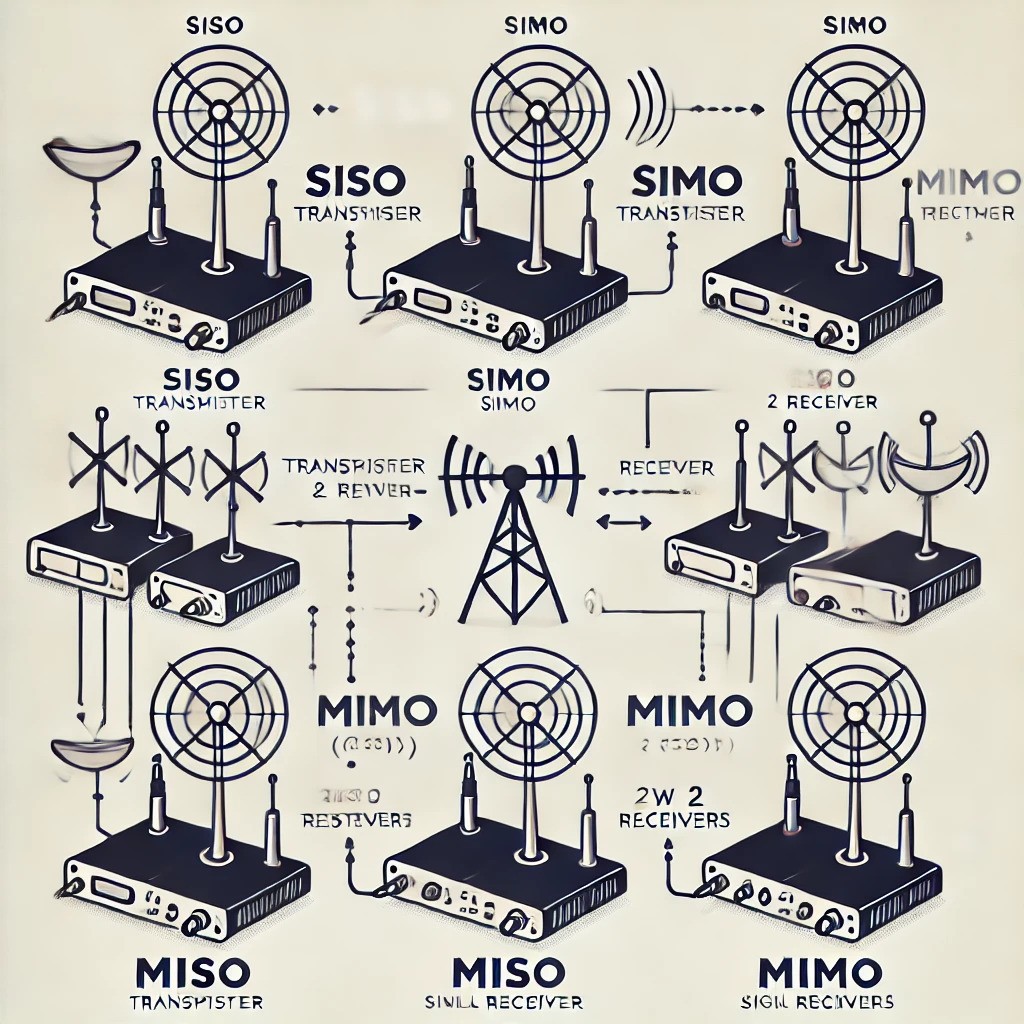
Project on SISO, SIMO, MISO, and MIMO 2022
Multi-Antenna Techniques & Their Applications Using Matlab
MINI PROJECTS
Billiard balls detection, Watermarking, fire detection
Digital Image processing Using Matlab and Python
MINI PROJECTS
Programming on 8051 Microcontroller
Principle of the computer system Using Keil uvision and STC-ISP
MINI PROJECTS
Digital Logic Design 2020
Digital Logic and digital system design Using vivado design suit for the hardware FPGA implementation
MINI PROJECTS
Circuits experiments 1 and 2 and digital experiment 1 and 2
Electric Circuit Experment using Multisim software
MINI PROJECTSMy Skills
A snapshot of the tools and technologies I use in research and development.
Programming
Document preparation & tools
Academic Sayings
Get in Touch
Send me a message and I'll get back to you soon!